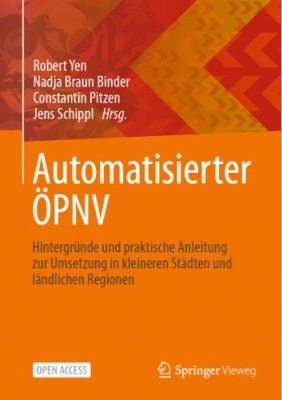

The handbook is intended as a practical tool for the targeted use of automated public transport on the way to the mobility transition.
If we want to be climate-neutral in the transport sector by 2035, a massive change in our mobility system is undoubtedly necessary. There is also no doubt that climate neutrality cannot be achieved through the electrification of motorized road traffic alone, but also requires a fundamental change in human behavior. Only if we succeed in placing people and their genuine needs at the center of the future mobility system will it be possible for people to adapt their behavior.
The editors of this handbook are convinced that this can be achieved and that the technologies are already available to us today. This handbook is dedicated to two of the key success factors of the mobility transition: on the one hand, public transport and, in particular, automated public transport as an alternative to motorized private transport and, on the other hand, those areas in which there is currently little demand for public transport and which are therefore inadequately served or not served at all.
Automated public transport can make a significant contribution to the mobility transition, as it can save high personnel costs in some cases. In the individual chapters, the authors from the fields of research, applied planning and consulting describe what is meant by automated public transport, the effects of automated driving, what requirements transport companies have for automated vehicles, how automated public transport is integrated, what legal aspects need to be considered in Germany, Austria and Switzerland when introducing automated public transport and much more.
The focus here is on the situation in cities and municipalities in more rural regions, although the various contributions should also provide many tips and suggestions for other spatial categories. The aim of the handbook is to provide the reader with a source of inspiration and assistance for specific projects that have already been started or are still to come - and which will hopefully contribute to a more sustainable mobility system overall.
Editors: Robert Yen, Nadja Braun Binder, Constantin Pitzen, Jens Schippl
> PDF | Handbook "Automated public transport" (in German)
> EPUB | Handbook "Automated public transport" (in German, external link)