Why automated driving in public transit must move beyond the experimental phase.
Automated driving in public transportation is no longer just a vision of the future. Vehicles are being tested on real roads, operating areas are being approved, registered users are booking rides via an app, and transportation companies are beginning to establish new structures for driverless fleets. Projects such as KIRA in the Rhine-Main region, ALIKE in Hamburg, ABSOLUT in Leipzig, and Artour in Arbon, Switzerland, clearly demonstrate this.
This is an important step forward for the industry—but not yet a breakthrough. So how can we provide a sustainable, scalable, and reliably funded public transit system?
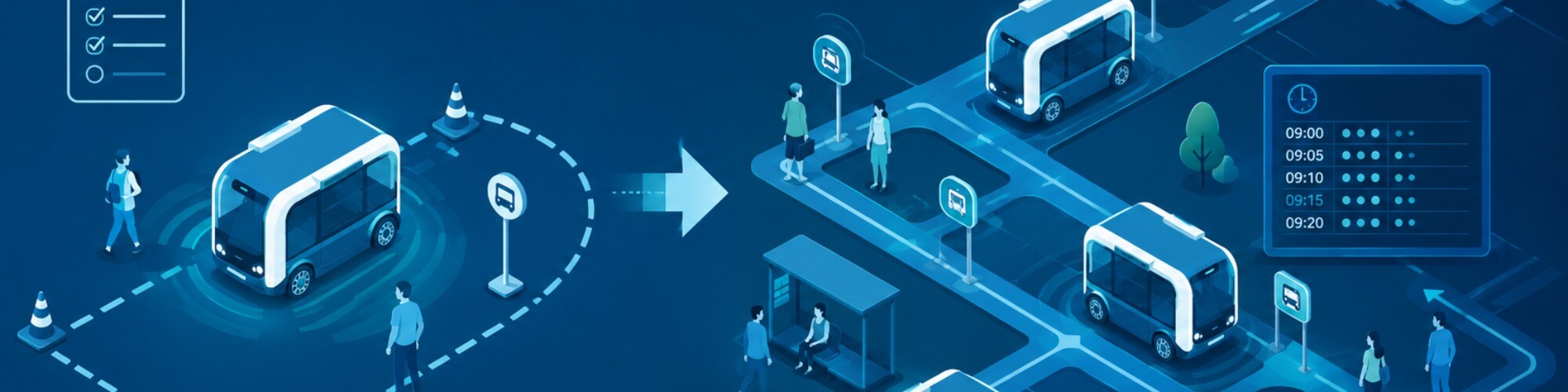
The pilot program demonstrates that the system works, but not that it is suitable for everyday use
Pilot projects are necessary. They bring prototypes onto real roads, make the technology tangible, and build trust. They show how passengers react, how regulatory agencies evaluate the technology, how vehicles handle complex situations, and what new operational processes emerge.
In pilot projects, however, not all system components have yet reached the level of maturity required for everyday use: They are temporary, geographically limited, heavily subsidized, and receive special organizational support. They often operate under conditions that only partially correspond to those of future routine operations. Additional project teams, special processes, safety drivers, research budgets, and a high level of attention help ensure that the testing remains stable.
Continuous operation leaves less room for error
In continuous operation, the service must function every day—not just in good weather, not just with selected test users, not just on a short route, and not just for the duration of a project. It requires robust processes, clear lines of responsibility, solid contracts, sustainably funded operating costs, available vehicles, trained staff, reliable data, and an organization capable of managing disruptions. The fact is: The transition from a pilot project to regular operation is not just another test—it’s a system change.
The political goal has been articulated
In its strategy “The Future Drives Autonomously,” the German federal government has clearly stated that automated driving should transition seamlessly from pilot operations to regular service. The focus is explicitly on public transit and on integrating automated vehicles into a connected, multimodal mobility system [1]. Germany is also well ahead from a legal standpoint and plays a pioneering role in legislation compared to other European countries. Level 4 vehicles can operate in individually approved operational areas; in addition, testing opportunities are available through the Federal Motor Transport Authority [2].
While this does not mean the legal framework is a blank slate, a trial operation does not yet constitute regular operation.
Model Regions as “Real-World Laboratories”
The Agora discussion paper [3] calls for a clear shift away from small-scale pilot projects toward reliably funded model regions. Large model regions in both urban and rural areas are intended to provide the necessary experience for routine operations while also helping to coordinate regulation, financing, and integration into the existing public transit system.
From our perspective, this is a necessary and important shift in perspective. We expect answers regarding how the overall system functions in different types of areas—with real passengers, a significant number of vehicles, connections to regular bus service and rail, robust operational processes, and so on—over a period of several years, including the ability to apply these lessons to other regions.
It is only on this scale that the effects on traffic become apparent.
Scaling means rethinking processes and enabling rollout
Scaling is often equated with fleet growth: more vehicles, larger service areas, more passengers. While this is part of the picture, it doesn't tell the whole story.
As the fleet grows, the importance of the underlying operational processes increases significantly. Technical supervision, remote assistance, incident management, data management, passenger communication, and quality monitoring must be organized in such a way that they do not become proportionally more complex and labor-intensive with each additional vehicle. Processes must be standardized, automated as much as possible, and clearly defined in contracts. This shifts the focus to the overall system.
Public authorities and transit agencies should therefore not wait until vehicles are fully market-ready. Even during the testing phase, product requirements, roles, interfaces, operational processes, and quality metrics must be harmonized as much as possible. The white paper by VDV and Hamburger Hochbahn outlines a development path for this, starting with the testing of different vehicle types and progressing to a scaling phase beginning in 2028/29 involving several hundred automated vehicles, with significantly larger fleets in the long term [4].
Interoperability is key to the rollout
Scaling must not be limited to the boundaries of a single service area. For a Germany-wide and Europe-wide rollout, the goal cannot be to have to completely redevelop and integrate vehicles, platforms, control centers, and operational processes for each new area. Interoperability becomes a key functionality. It encompasses, among other things, data formats, vehicle and backend interfaces, control center integration, technical oversight, operational processes, quality metrics, and infrastructure and regulatory requirements.
The more standardized and transferable these building blocks are, the less effort it takes to adapt an existing system to a new transportation area.
This benefits the entire industry: Manufacturers and system providers can develop products and services more cost-effectively and deploy them across multiple regions. Transit agencies and public authorities do not have to develop their own technical and organizational solutions for every project. And regions outside the initial “first-mover” group can draw on proven architectures, processes, and contract models, rather than spending years building up their own expertise and proprietary, one-off solutions.
The goal must therefore be to develop replicable operating models based on successful pilot projects: solutions that not only work in one location but can also be adapted to other cities, regions, and operators with a manageable amount of effort. Only then will scaling become a true rollout—and individual automated public transit projects will give rise to a viable market.
Real passengers are changing the requirements
As long as a project is running with test participants and limited operating hours, the focus is on the technology. With real passengers, the focus shifts. Then what matters most are reliability, clarity, a sense of safety, accessibility, incident management, and integration into everyday life.
That is why the transition to open passenger service is so important. It shows whether a technical demonstrator will become a genuine mobility service. And it highlights which processes are still missing: intermodal passenger information, in-vehicle assistance, handling of lost and found items, emergency communication, alternative transportation, complaint management, accessibility, customer service, and other processes that often only become apparent on the periphery during pilot operations.
Rapp Trans supports public contracting authorities and transportation stakeholders in shaping this transition. To this end, we bring together the key issues related to transportation planning, technical system integration, operational processes, role models, procurement, data requirements, and financing models.
Now that the pilot projects are complete, it’s time for the next step: only when real passengers no longer view automated public transit as merely an experiment will its breakthrough be decided.
Author: Erik Schaarschmidt
Sources:
[1] Federal Ministry of Transportation (2024): The Future Is Autonomous. The Federal Government’s Strategy for Autonomous Driving on Public Roads.
[2] Research Services of the German Bundestag (2026): Autonomous Driving—Legal Framework and Market Introduction in Germany, WD 5 – 3000 – 038/26; WD 7 – 3000 – 022/26.
[3] Agora Verkehrswende (2026): Germany as a Leading Market and Provider of Autonomous Public Transit. Potential, Obstacles, and Options for Action Regarding Automated Trains, Driverless Buses, and On-Demand Shuttles.
[4] Hamburger Hochbahn AG / VDV (2025): Autonomous driving in scheduled local public transit services.


 AI-generated